What is a commercial food warmer?
A commercial food warmer is a piece of equipment designed to keep already cooked food hot while waiting to be served. However, this does not mean that the food continues cooking inside it: its function is instead to slow down the cooling of preparations and keep them within a temperature range that is suitable for service and, in many cases, also for food safety.
What temperature should food be kept at? In general, these systems operate within a range of about 60 to 90°C, although the actual value depends on the type of food, the specific application, and local regulations. In many professional settings, the minimum reference threshold is above 65°C, while in very high-volume operations or contexts with stricter internal protocols, even higher temperatures are used.
Another key aspect concerns time: how long can you keep food in a food warmer without risk? In most cases, hot holding is used temporarily, meaning during the period between the end of cooking and the moment of consumption or plating. This is why the commercial food warmer buffet is used especially in buffets, catering, kitchen passes, canteens, and self-service lines, namely in all those preparations intended for fast service.
The operational advantage of these systems is clear: they help reduce pressure during service and make it possible to manage part of the preparations in advance. The real point, however, is another: how long can I keep food inside without damaging its quality? From a qualitative point of view, in fact, everything depends on how well the system is actually able to control what happens inside the holding chamber.
Types of commercial food warmers
In professional kitchens, there are different solutions for hot holding. They vary in shape, capacity, and level of control depending on the needs of the business, but the goal of a commercial hot food warmer remains the same: to keep food at the right temperature until the moment of service.
Countertop commercial food warmers
Compact food warmers are often used in small venues, buffets, snack bars, food corners, and self-service lines. These are solutions designed to keep limited quantities of product hot and to provide practical, immediate, and fast use where space is limited.
They are well suited to settings where some preparations need to be ready to serve, and they usually offer fairly basic control of internal conditions. For this reason, they are especially useful for short-term holding.
Large commercial food warmer cabinets
Hot holding cabinets are professional units designed to hold larger volumes of food. They are commonly used in professional kitchens that need to manage large quantities of preparations, such as hotels, canteens, catering operations, or centralized production kitchens.
Compared with compact models, they offer greater capacity and more organized workflow management, but they do not always guarantee truly precise and even temperature control throughout the entire chamber. As capacity increases, in fact, it can become more difficult to maintain perfectly stable conditions.
Commercial mobile food warmer carts and systems for large volumes
In high-output settings such as hospitals, large canteens, and production centers, closed or covered thermal carts are also used, designed to transport and keep food hot up to the point of distribution.
These are very common solutions in institutional foodservice, where the main issue is not only cooking, but also the logistical management of service. In these cases, hot holding becomes an integral part of the production flow, even though the actual level of control can vary greatly from one technology to another.
Oven holding function: the Cook & Hold system
Another widely used solution is the Cook & Hold function available in some professional ovens. This is a hybrid system that combines a cooking phase with a subsequent holding phase.
It is a useful function, for example, for overnight cooking or for preparations that need to remain at temperature for a limited time after the end of the cycle. It is worth emphasizing, however, that a professional oven can be effective for short and well-planned holding, but it is not designed as a specialized system for prolonged hot preservation. Control over ideal holding conditions therefore remains more limited than with a technology developed specifically for that purpose.
The limits of traditional commercial food warmers
Traditional commercial food warmers meet a real need in professional kitchens: keeping food hot between the end of cooking and the moment of service. However, when holding times become longer, some structural limitations begin to emerge. Most of this equipment is designed for relatively short periods, often within two hours, and only in some cases up to four.
Today, with a foodservice industry increasingly focused on efficiency, operational continuity, and waste reduction, this approach is becoming less and less suitable. What happens when you need to keep food hot for longer? Which dishes actually perform well, and which start to lose quality?
Temperature management
One of the main issues with traditional commercial food warmers concerns temperature stability. Not only is the heat not truly even throughout the entire chamber, but temperature fluctuations also occur frequently. These variations have a direct impact on food: they can speed up overcooking, change the structure of the product, and alter its texture.
Take meat, for example: unstable temperature tends to affect the protein fibers, making the product less compact and less pleasant to bite into. Or cooked pasta, which tends to overcook over time, or fried food, which gradually loses its crispness.
Humidity levels
Another critical limitation concerns humidity management. Is it really possible to control humidity inside the chamber? How does food warmer work when it comes to preventing food from drying out or becoming soggy?
Some electric commercial food warmer units allow a small percentage of humidity to be introduced, but that does not mean it is actually controlled. In practice, a temperature is set and, in some cases, humidity is added, but the internal atmosphere is not truly managed.
This is where a physical principle that is often underestimated comes into play: hot food naturally tends to release moisture into the surrounding environment. If the air is too dry, the product dehydrates. If it is too humid, it loses structure. That is why many foods are especially difficult to manage.
Fried foods, for example, require a low-humidity environment to maintain crispness. But if the internal humidity rises, as often happens in poorly controlled chambers, the surface absorbs steam and the product becomes soft. In the same way, preparations such as meat, braised dishes, or foods with sauce require the opposite conditions to avoid drying out.
The result is that many traditional systems are not really able to adapt to the specific behavior of each food. This leads to a gradual loss of quality: textures change, colors darken, and aromas fade.
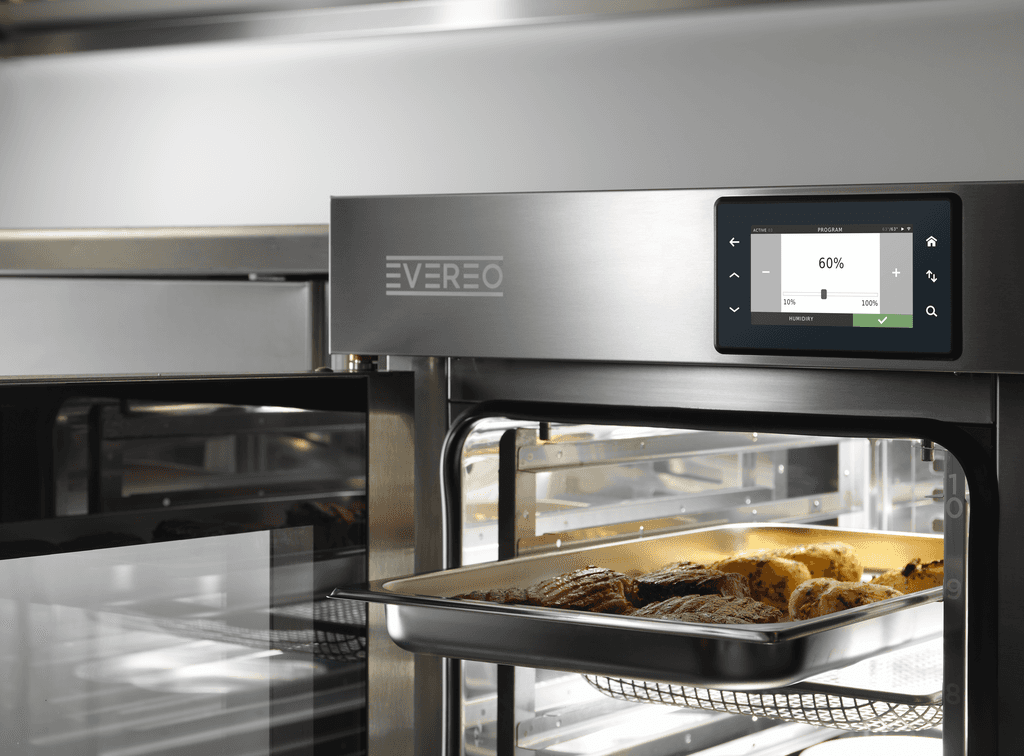
EVEREO®: a preservation solution that goes beyond the limits of hot and cold holding
How can the limits of traditional commercial food warmer systems be overcome while at the same time ensuring quality and safety in food preservation? This question is where Unox’s research journey began: work developed with the aim of preserving in stored food the same quality as freshly prepared food.
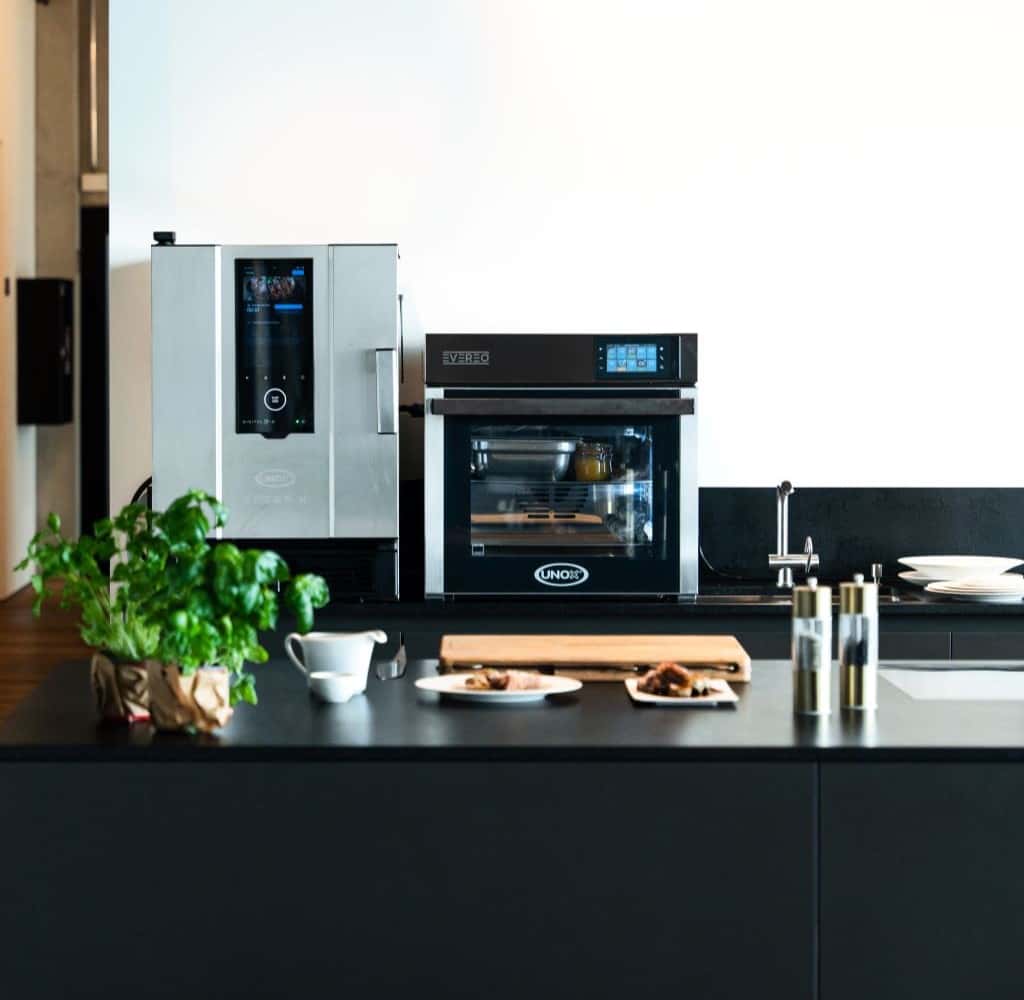
After years of study and development, Unox patented a technology that is unique on the market and certified by HACCP International. Created in collaboration with the University of Parma, EVEREO® is the first professional solution capable of preserving cooked food hot at serving temperature for far longer than just a couple of hours, up to three days, without compromising its organoleptic properties. Taste, texture, aroma, and quality remain preserved over time.
This opens up completely new possibilities in the kitchen. It means being able to prepare food in advance without losing quality, reduce workload peaks during service, organize the line more efficiently, and limit waste while maintaining high and consistent standards.
But how is it possible to preserve food for days?
The answer lies in control. EVEREO® has been designed to precisely manage the factors that truly affect hot preservation: temperature, humidity control, and oxygen reduction around the product. This is exactly where the research started: understanding not only whether it was possible to preserve food hot safely, but also how to prevent that gradual deterioration in color, aroma, structure, and texture that characterizes traditional systems.
To achieve this result, Unox developed a dedicated technological ecosystem. EVEREO® maintains an extremely stable temperature, generally above 63°C, avoiding thermal fluctuations and helping create conditions that prevent bacterial growth. At the same time, it does not add humidity indiscriminately, but manages the moisture naturally released by food, preventing uncontrolled accumulation or dispersion inside the chamber.
Another decisive element is oxygen control. For this reason, Unox developed MULTI.Day trays and lids, designed to move directly from cooking to preservation without intermediate cooling, and MULTI.Day Hot Vacuum, the first patented technology that makes it possible to create a vacuum while the food is still hot. In this way, oxidative processes are reduced and texture, moisture, color, and aroma are preserved for longer.
In this way, EVEREO® goes beyond the limits of the traditional commercial hot food warmer and, in some applications, can also represent an alternative to cold preservation processes followed by regeneration. Compared with traditional commercial kitchen food warmer systems, it guarantees greater stability and control. In certain contexts, compared with refrigeration, it makes it possible to avoid cooling and regeneration cycles, reducing operational steps, energy consumption, and pressure on the kitchen brigade.
To learn more about how does food warmer work in this system and discover how it can simplify kitchen operations while reducing stress in the kitchen, read the dedicated article.
EVEREO® is revolutionizing professional kitchens around the world
It is in real-world applications, across different foodservice sectors, that the EVEREO® hot preservation system has fully expressed its potential. From large-scale retail to catering, from hospitality to fast foodservice, this technology has proven capable of deeply transforming organization, working times, service quality, and food management, adapting to the specific needs of every operational context.
Retail and supermarkets
One of the sectors where EVEREO® finds its greatest application is large-scale retail. Supermarkets and deli counters must simultaneously manage the production of ready meals, direct customer service, and continuous product turnover.
This simplifies processes, reduces waste, and ensures greater continuity of offer, as also demonstrated by the adoption of EVEREO® by major retail companies such as Coop Italia.
“When EVEREO® truly becomes part of the daily work of a supermarket, the difference is immediately visible: everything becomes easier for the staff to manage, the deli counter is replenished more easily throughout the day and, above all, it becomes easier to expand the offer. This is even more noticeable in supermarkets that, in addition to the deli counter, also have a foodservice area, because there the need to coordinate preparations, timing, and quality is even more evident” comments Alfredo Mortara from the Unox Sales Team.
Catering and large volumes
In the catering world, EVEREO® represents a real paradigm shift. It allows large quantities of preparations to be produced in advance, maintaining quality and safety over time and reducing operational pressure during service.
Its value emerges especially in contexts where, in addition to volume, logistical complexity also matters. Events, banqueting, and wedding catering require not only large numbers, but also high quality standards, precise timing, and coordination between production and service.
In these scenarios, the possibility of separating the preparation phase from the moment of service becomes a real competitive advantage.
Hotels and organized foodservice
In the hospitality sector, one of the main challenges is ensuring continuity and quality even when service must remain active 24 hours a day. This is the case, for example, with room service, large events, or facilities that must manage high volumes without always being able to rely on the presence of a chef dedicated to à la minute preparation.
In this context, EVEREO® makes it possible to optimize production, reduce waste, and maintain a consistent quality standard even during the most complex moments. The possibility of working in advance without compromising final quality helps kitchens organize workflows more effectively and respond more efficiently to guest requests.
“We have the possibility of having things prepared by the morning shift for the event, which can sometimes involve up to 2,000 people. We can work well in advance. We place the food in EVEREO®, which preserves it impeccably,” says Paul Bates, Executive Chef at the Hilton London Metropole, explaining how this technology has helped simplify operations in one of the most complex hospitality settings.
Read the interview and watch the behind-the-scenes video from the kitchens of the largest Hilton hotel outside the United States!
Restaurants
In the restaurant world, the use of EVEREO® varies greatly depending on the service model. In à la carte restaurants, for example, the challenge is not only cooking well, but also ensuring that every dish is served at the right time, without stress and without one plate cooling down while waiting for the rest of the order.
This is exactly where, especially in more compact configurations such as EVEREO® Cube, it can become an intelligent support station: a point where ready dishes can be temporarily held before plating. In more structured contexts, such as events or fixed menus, having a higher-capacity configuration like the standard EVEREO® model offers an even greater advantage, as it allows for advance preparation and better organization of kitchen workflows.
Fast foodservice
In fast service, the challenge is almost always the same: reducing waiting times without compromising quality. It is precisely in this delicate balance that EVEREO® can make a difference. The ability to have products ready for service, maintained under controlled conditions, allows operators to manage peaks in demand with greater operational continuity, without sacrificing quality. This aspect becomes even more important in large chains, where not only speed but also standardization and consistency across every location are essential.
Pastry and delicate preparations
In pastry, precision is everything. Even minimal variations in temperature or humidity can compromise the consistency, structure, and final result of preparations. This is why managing creams, chocolate, or delicate processes requires extremely accurate control.
EVEREO® makes it possible to work with maximum precision, maintaining stable and controlled conditions over time. It can be used to manage creams, bases, candied products, or chocolate, preventing issues such as crystallization, loss of texture, or structural alterations.
It is precisely this level of control over internal conditions that has also opened the door to new applications and working techniques in the foodservice world. To explore this aspect further, you can read our dedicated article.
Would you like to try EVEREO® for free in your kitchen? A technology like this can truly be understood only when tested in real conditions. That’s why Unox offers professionals the opportunity to try EVEREO® directly in their own kitchen for a few days, allowing them to concretely evaluate its performance, results on dishes, and real impact on workflow organization.
In some cases, the test can also be carried out in combination with a Unox professional oven, to explore the full potential of our intelligent technologies.
Visit the dedicated product page and feel free to contact us via chat for a tailored consultation!