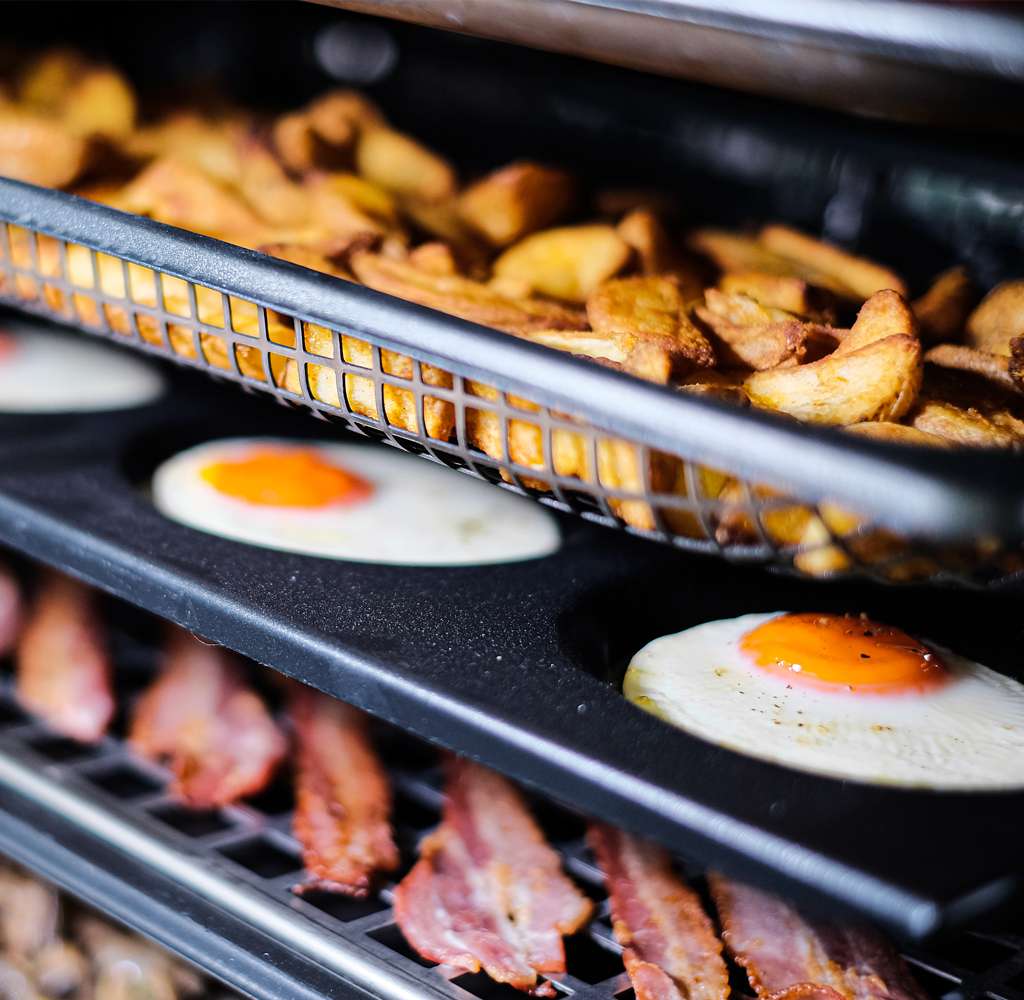
Types of commercial baking trays: comparing materials
What is the best material for commercial baking trays? Is it better to choose aluminium, stainless steel or blue steel? The answer depends not only on the preparation, but also on the type of oven, the temperature reached during cooking and the desired finish. Let’s look together at the main differences between the various materials available.
Commercial baking trays made of aluminium are a true classic in the world of pastry and bakery. Aluminium conducts heat extremely quickly and evenly, making it perfect for cookies, shortcrust pastries, croissants and all preparations that require a dry base and uniform browning.
Are aluminium commercial baking trays safe? The answer is yes: food-grade certified trays are among the most reliable and high-performing solutions in the professional environment.
The behaviour of stainless steel commercial baking trays is completely different. Here the key word is resistance: stainless steel withstands intensive use, frequent washing and maintains a stable structure over time. It is the most commonly used material in gastronomy and foodservice, especially when working with moist preparations or heavy loads. Heat conduction is slower than aluminium, but its durability fully compensates for this aspect.
The most “specialised” material, instead, is blue steel. It is the choice for those seeking intense crispiness, high heat retention and stable performance even at extreme temperatures—up to 500°C. This makes it the ideal tray for sheet-pan pizza, focaccia and high-hydration breads: doughs that require strong thermal push from below and a well-cooked base.
Last but not least, remember that beyond the base material, it is always good practice to consider choosing commercial baking trays with a non-stick coating (the classic PTFE-coated trays). They are essential for all preparations that risk sticking (soft cakes, eggs, delicate doughs) and simplify daily work by reducing the need for fats and speeding up unmoulding.
Perforated vs smooth commercial oven trays: how do they affect cooking differently?
Once you understand the difference between the various materials, another choice comes into play—one that can determine the outcome of your cooking even more: is it better to use a perforated commercial baking tray or a smooth one? In a convection oven, air is what transports heat, and the trays themselves guide its trajectory inside the chamber.
Perforated commercial baking trays act like a natural boost for crispiness. The small holes allow heat to reach the product from below as well, encouraging moisture evaporation and creating that dry, even base that makes all the difference in many preparations. They are the ideal choice when you aim for a firm texture: bread comes out lighter, choux pastry dries perfectly. It is the tray you choose when you want more “push” and a texture that leaves no doubt.
Smooth commercial baking trays, on the other hand, are the trusted companions of everything that needs support. Whipped masses, delicate cakes, liquid or semi-liquid doughs all need a full surface that can contain them and accompany them through baking. Here, crispiness is not the priority—stability is. A smooth tray distributes heat more gently and evenly, without overdrying the product. It is the right solution when you need to preserve volume, softness and structure.
In short, the choice is simple.
Want crispiness? Go for a perforated tray.
Want support and delicacy? The smooth tray is your best ally.
Sizes of commercial oven trays: everything you need to know
It may sound trivial, but choosing the wrong size of a commercial baking tray is one of the most common mistakes. Even a slightly non-standard tray becomes unusable, which means wasted time, money and efficiency.
To avoid this, it’s essential to know the two main standards that define the world of professional trays: Euronorm and GastroNorm.
Euronorm commercial baking trays, the classic 60×40 trays, are the most widely used in the bakery and pastry world. They offer large cooking surfaces, allow high-volume production and fit perfectly in ovens specifically designed for leavened products, cookies, puff pastry and large doughs.
GastroNorm trays, on the other hand, are the international standard in gastronomy and foodservice. The most common size is GN 1/1 at 530×325 mm: more compact and manageable, ideal for service, ready-meal preparation, regeneration and all operations typical of “hot” professional kitchens.
How can you understand which format to choose for your oven? Simple: always check the standard for which the oven was designed. Manufacturers of professional ovens clearly indicate whether the model supports GN, EN or both types of commercial baking trays. Making the correct choice from the start helps you avoid costly mistakes and allows you to work smoothly, without interruptions.
Cleaning and maintenance: how to make your commercial baking trays last longer
In a professional kitchen, trays are among the most heavily used tools: exposed to high temperatures, humidity, thermal shock and constant handling. And this combination makes them some of the easiest accessories to damage. This is why maintenance is one of the most discussed topics among professionals. How do you properly clean a Commercial baking tray? Can it go in the dishwasher? How long can it last? And how can you prevent it from turning black over time or, even worse, warping?
Some trays—especially the thinner ones or those not designed for high temperatures—tend to warp when pushed beyond their intended thermal range. This is where the difference between materials truly matters: each reacts to heat differently, and knowing these characteristics allows you to extend the life of your commercial baking trays by years.
Blue steel trays, for example, are unbeatable in terms of high-temperature performance; they easily reach 500°C, but they have a particular trait that often surprises first-time users: they must be “burned in” before use. The famous seasoning creates a naturally non-stick surface and protects them from rust. Once prepared, they are cleaned without water or soap: a scraper and a light layer of oil are enough to keep them in perfect condition.
Aluminium commercial baking trays, instead, tend to darken with use. This is not a defect: it’s normal behaviour for this material. When deeper cleaning is needed, hot water and baking soda work best, avoiding overly aggressive products that could dull or scratch the surface.
Dishwasher? Better to avoid it—but if you really need it, you can use it with the right precautions, choosing dedicated detergents.
A different story applies to stainless steel commercial baking trays, which are much more robust and resistant to frequent washing. Here, the dishwasher is not a problem, and this is one of the reasons why they are so widespread in high-volume professional kitchens.
Non-stick commercial baking trays require attention and care: the coating performs perfectly only if treated correctly, and the dishwasher tends to damage it. Hand washing—quick but consistent—is the best solution.
In short: knowing how to care for a tray means protecting its value and ensuring more consistent, predictable and efficient cooking. Proper maintenance not only improves performance—it keeps materials intact, prevents unwanted contamination and guarantees safer, healthier preparations for both those who cook and those who consume food.
Why choose a professional Unox oven tray?
When you choose a professional Unox oven, you’re not just choosing a piece of equipment: you’re choosing a complete system, engineered to work in harmony down to every single component. Commercial baking trays are no exception. Each tray is studied, tested and developed to interact flawlessly with the cooking chamber, the airflow patterns and the intelligent technology that defines every Unox oven.
This is why choosing a professional Unox tray means gaining concrete, measurable advantages:
• They are perfectly compatible with the cooking chamber and airflow of Unox ovens, ensuring heat reaches exactly where it’s needed.
• They offer true versatility, because they are designed to perform at their best both in combined cycles and in those dedicated to specific cooking processes.
• They reduce cooking times, helping lower energy consumption and making your work more efficient—even during the most intensive production.
• You always have dedicated support and assistance: if you have doubts, questions or specific needs, a team is ready to guide you.
In a market full of alternatives, choosing commercial baking trays designed specifically for your oven means achieving better results, working faster, consuming less and maintaining consistent quality over time.
What are the best Unox commercial baking trays for pastry and bakery?
烘焙行业在Unox专业烤箱中找到了完整的解决方案系列,既能满足大型实验室的需求,也能适应手工糕点店和面包店的需求。BAKERTOP系列旨在提供最大程度的多样性,让您以最小的努力和最佳的效果制作无数烘焙产品。但每个专业人士都知道:即使是最好的烤箱也需要合适的烤盘才能发挥最佳性能。在烘焙中,变量很多,这正是为什么烤盘的选择可以产生巨大差异。为了支持各种类型的准备工作,我们开发了Baking Essentials,这是一系列旨在陪伴您度过每一天各个阶段的烤盘。
最受欢迎的型号包括带有硅胶涂层的微孔铝制商用烘焙烤盘FORO.SILICO:它们耐高温并充分利用烹饪室内的气流,确保可颂、酥皮和发酵产品完美均匀。
为了最佳地烘烤法棍和短棍面包,我们创建了FORO.BAGUETTE.BLACK,同样是微孔设计并配备不粘涂层,甚至提供带有形状通道的版本,旨在支撑特定面包形状。
另一个受欢迎的选择是寻求最大烘焙灵活性的FAKIRO专业烤盘。一个具有双表面(光滑和带肋)的烤盘,能够模仿耐火石的行为:一个实用有效的解决方案,用于实现酥脆的底部和更好的保温效果。
在节日期间呢?当潘妮托妮和复活节鸽子成为生产明星时,我们的带有对称针系统的不锈钢烤盘就派上用场了,旨在支撑细腻的面团并创造高圆顶、酥脆外皮和宽大的面包屑结构。PANETTONE.Bake烤盘适用于1公斤潘妮托妮(模具ø 165-170毫米),COLOMBA.Bake烤盘适用于750克复活节鸽子(模具295×205毫米)。
我们为每种糕点和烘焙需求都准备了商用烘焙烤盘。访问专用页面并发现完整系列!
最适合熟食和烤肉店的商用烤箱烤盘有哪些?
您知道吗?使用Unox组合烤箱,您可以烧烤、蒸煮、油炸、烘烤等等!CHEFTOP系列正是为此而设计:让餐厅、熟食店和烤肉店能够扩展菜单而无需添加新设备,使用单一专业烤箱在最小空间内覆盖多种烹饪技术。
我们再次没有止步于烤箱。为了确保每个性能参数(从气流到湿度水平)都能充分发挥潜力,我们开发了一条专门的商用烘焙烤盘系列:Cooking Essentials,旨在支持烤箱的所有功能。使用这些烤盘,您可以烤鸡、烘烤大量面包、焗烤千层面、准备烤牛肉、烹饪蒸煮或炒制的配菜……等等,轻松自如。下面您将看到为每种烹饪技术设计的商用烘焙烤盘概述,以及它们为何适合特定准备工作。
蒸煮和真空低温烹饪
对于蒸煮和真空低温烹饪,您需要一个能够增强室内蒸汽循环的烤盘。
STEAM烤盘是一个底部带有微孔的不锈钢烤盘,非常适合让蒸汽精确到达需要的地方,确保均匀可控的烹饪。STEAM&FRY则结合了底部和侧面的穿孔——当您想在不更换配件的情况下交替进行蒸煮和油炸时非常完美。
油炸
如果您正在寻找专门用于油炸的烤盘,我们的POTATO.FRY是理想解决方案:由钢材制成,底部和侧面带有穿孔以及波浪表面,确保恒定气流,使薯条和油炸食品外脆内软。
除此之外,您还会发现BLACK.FRY,带有波浪表面的不粘钢商用烘焙烤盘,以及CLEAN.FRY,配备不粘集油盘,可减少残留物堆积并保持烹饪室更清洁。
烧烤
要实现完美的烧烤,仅仅提高温度是不够的——您需要合适的烤盘。我们的POLLO.GRILL,由钢材制成并配备集油盘,旨在处理释放液体和油脂的烹饪过程,如烤鸡,但也非常适合其他肉类和类似准备工作。对于所有其他烧烤需求,有CHROMO.GRILL,我们的镀铬烤架带有把手,便于装卸,同时保证干净均匀的烤痕。
如果您寻求最大程度的多样性,FAKIRO GRILL是理想配件:一个不粘铝制商用烘焙烤盘,具有两个表面——一侧光滑,另一侧带肋——让您能够交替使用不同的烹饪技术。与传统煎炸台相比,它可以将烹饪时间减少高达30%,同时始终保持出色的烧烤质量。
最适合小吃和酒吧产品的商用烘焙烤盘有哪些?
除了为组合烤箱中更复杂准备工作设计的商用烘焙烤盘外,Unox还提供一系列专为我们专业加速烹饪烤箱设计的配件。在这里,速度、多样性和质量必须完美共存——这就是为什么我们开发了专用烤盘,能够最大化性能并最小化服务时间。
从SPEED.Grid,旨在确保最大气流循环的超轻不锈钢网格,到SPEED.Basket,允许您一次烹饪多种小吃并充分利用烤箱室的半刚性不粘容器,每个配件都旨在提高生产力和操作自由度。
您甚至可以通过SPEED.Marks将您的SPEED.Pro™加速烹饪烤箱变成真正的煎烤盘,这款不粘铝制商用烘焙烤盘具有双表面——一侧光滑,另一侧带肋——以及开槽顶板。搭配专用铲子快速摆放和取出食物,它为标记三明治提供了最大多样性:您可以选择单面或双面烧烤,始终获得均匀结果。
立即发现适用于酒吧和其他快餐服务企业的Unox商用烘焙烤盘完整系列!