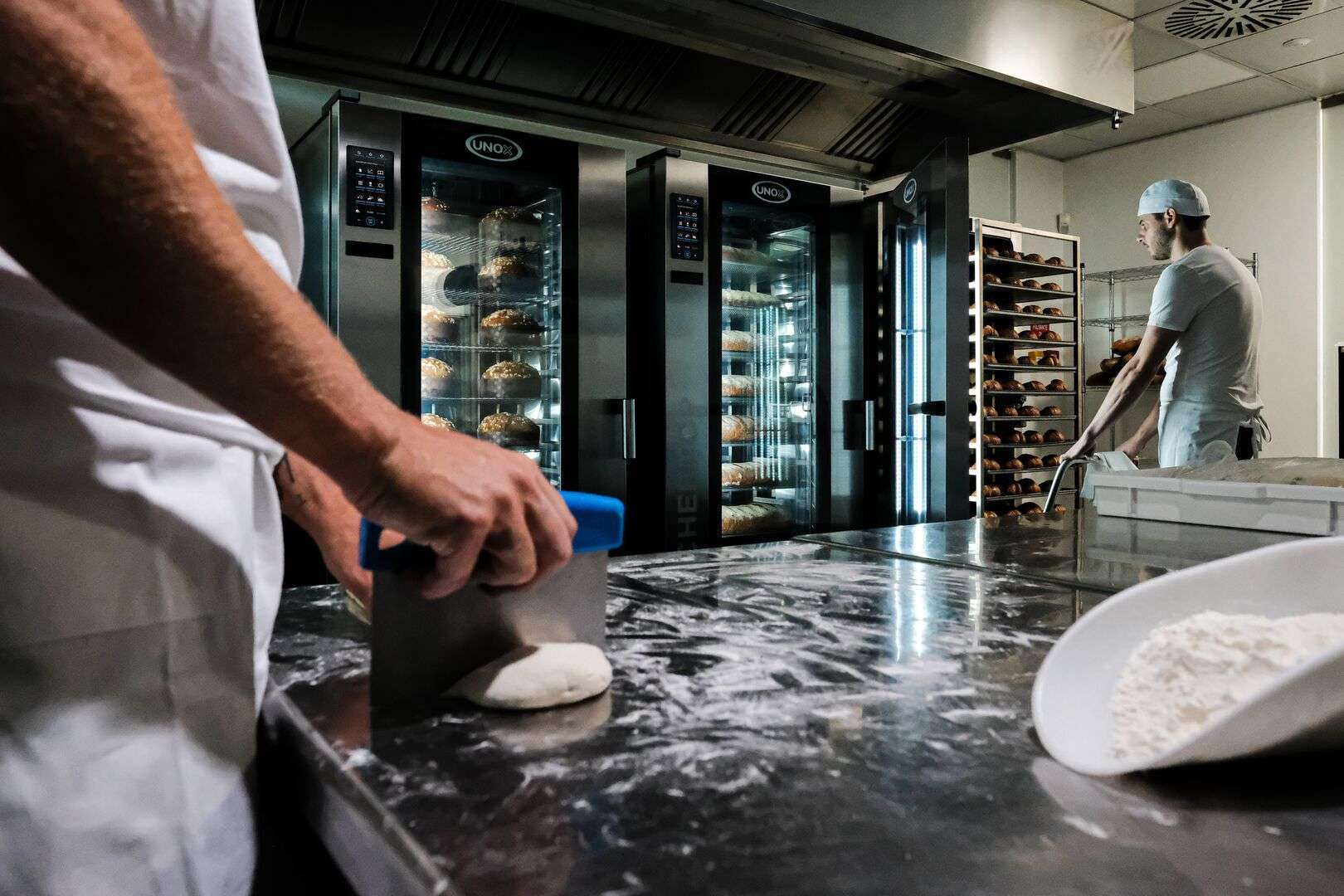
How to bake panettone in a commercial oven? Here’s what’s essential for large yeast-leavened products
Let’s not beat around the bush: you can start with the best flour, a perfectly managed sourdough, and flawless dough, but if the commercial oven isn’t working correctly, the panettone risks losing all its potential. To achieve a well-developed dome, regular vertical rise, and even crumb, a commercial oven for panettone must precisely control three key variables: heat, humidity, and airflow.
The difference between a picture-perfect product and a disaster that collapses or dries out comes down entirely to these three factors:
- Stable heat transfer from the start: when you load the oven, the dough is around 26°C. If the baking chamber suffers a sudden temperature drop (the classic loading thermal shock), development stops: the panettone loses lift, settles, and “falls”. You need stable heat that reacts immediately from the very first second.
- Steam at the right moment (and no “elephant skin”): in the first few minutes, humidity is crucial. Steam keeps the surface of the dough elastic and soft, allowing the panettone to expand freely without barriers. If the chamber is too dry, a hard crust forms immediately, breaking the dome irregularly or creating that unpleasant wrinkled effect.
- Airflow control: moving air is a fantastic ally because it speeds up baking, but with panettone it must be handled delicately. If the fans blow too strongly, the outer crust dries too quickly, halting growth and leaving you with a dry interior.
Which type of commercial oven can ensure such precise and versatile control? Let’s explore the different technologies on the market and the most popular choices among pastry chefs today.
Static, rotary, or convection oven for panettone: what’s the difference and which is best?
If you put ten master pastry chefs in the same room and ask which system is perfect for baking large yeast-leavened products, you’ll witness an endless debate: is it better a static, convection, or rotary commercial oven for panettone?
The truth is that two different machines, even when set to the exact same temperature on the display, often produce completely different results. Why? Because temperature is just a number, the real difference lies in how heat is transferred to the product. If you’re looking for the right equipment for your artisanal production, you need to understand how these technologies perform when the baking chamber is fully loaded.
The traditional static oven
Many professionals still choose a static oven for one clear reason: the absence of forced airflow. Heat is transferred by contact (from the refractory stone of the oven floor) and by radiation (from the ceiling of the chamber). In modern commercial static ovens, separate control of the ceiling and floor can be set as a percentage (0–100%) or through continuous electronic modulation, the latter being the only method that ensures true thermal stability, preventing harmful peaks.
However, commercial static ovens have structural and economic limitations that weigh on the bakery. They require a very tall oven chamber (at least 25–30 cm): if you bake a 1 kg panettone in a standard chamber, the dome rises too close to the heating elements and burns before the center is cooked. In addition, baking times are long (about 1 hour and 20 minutes for an 800 g loaf), and the high thermal inertia results in high energy consumption and low versatility if you need to bake small pastries or delicate puff pastry immediately afterward.
The commercial rotary oven (Rotor)
The commercial rotary oven is a convection giant: an entire rack of trays rotates continuously while a powerful flow of hot air is pushed into the chamber. Anyone who needs to bake hundreds of pieces per day always asks the same question: does the rotary oven guarantee the same softness and humidity as a static oven, or does the forced air risk creating a crust that is too thick and dry?
Unfortunately, the answer leans toward the latter. The rotary oven is designed to standardize large volumes of bread or cookies, but for large yeast-leavened products, the forced air is too aggressive. The risk of drying out the outer dome too early is very high, resulting in a panettone that does not fully develop and loses freshness on the shelf much faster.
The traditional convection oven
The commercial convection oven with fixed trays works on the same principle as the rotary oven, but on a smaller scale: one or more fans continuously circulate hot air inside the chamber. Many artisans wonder whether this technology could represent a middle ground between the delicacy of a static oven and the bulk of a rotary oven for their large yeast-leavened products.
In its classic version, however, the convection oven faces the same limitations as its “bigger brother”: continuous, non-adjustable airflow aggressively affects the surface of the panettone. Without the ability to control the air intensity, moisture in the dough evaporates too quickly, creating a dry barrier that blocks vertical rise and results in a dense crumb.
The real breakthrough to overcome this limitation is the evolution of the convection oven: the combi oven.
Commercial combi oven: why it’s the best oven for baking panettone
One of the most common questions among pastry chefs exploring multifunction ovens is: is the combi oven really suitable for baking panettone? The answer is yes. Its multifunctional nature allows precise control of all elements necessary for perfect baking: temperature, humidity, and airflow. This not only guarantees flawless panettoni, but also allows the same machine to be used for other baking and preparation tasks, increasing the versatility of the bakery. Let’s take it step by step.
Thanks to intelligent management of airflows, chamber humidity control, and precise fan speed regulation, combi ovens ensure even and gentle baking, preserving vertical rise, internal softness, and the organoleptic quality of the panettone.
Unlike a static oven, the commercial combi oven does not concentrate heat only from the ceiling and floor, but distributes it in a controlled manner throughout the chamber. This reduces the risk of the dome burning before the center is fully cooked and helps achieve more uniform coloring, without the need to manually rotate trays during baking.
The main advantages for the bakery are:
- Even baking even at full load: heat is distributed in a controlled way across all trays, reducing differences between panettoni placed at the top, bottom, or center of the chamber.
- Lower risk of dome burning: the panettone is not exposed to a direct heat source as in traditional static ovens. This helps achieve more uniform browning, preventing the surface from burning before the center is fully cooked.
- Preserved internal softness: humidity and airflow control help avoid a crust that is too thick and a dry crumb, keeping the panettone soft for longer.
- More efficient baking times: the heat exchange in a combi oven reduces baking times compared to a static oven. An 800 g panettone that might take around 1 hour 15–20 minutes in a static oven can bake in about 50–55 minutes in a Unox combi oven. This increases productivity and makes peak periods like Christmas and Easter easier to manage.
- More repeatable results: programmable baking cycles allow you to replicate the same process every time, even with different operators. Simply select the recipe, and the oven automatically manages temperature, humidity, and airflow.
- Year-round versatility: after the panettone season, the same oven can be used for croissants, choux pastry, puff pastry, small pastries, bread, and gastronomic preparations. A single investment works across multiple production lines.
- Higher productivity in less space: vertical configurations increase production capacity without taking up the space of a multi-deck static oven. Additionally, the versatility of the combi oven can help reduce the need for other dedicated equipment.
- Greater safety and operational comfort: in trolley configurations, operators can load and unload large quantities of product with simpler, controlled movements, without handling each hot tray manually. Insulating materials and ergonomic solutions help reduce the risk of burns, bumps, and awkward operations during the busiest production moments.
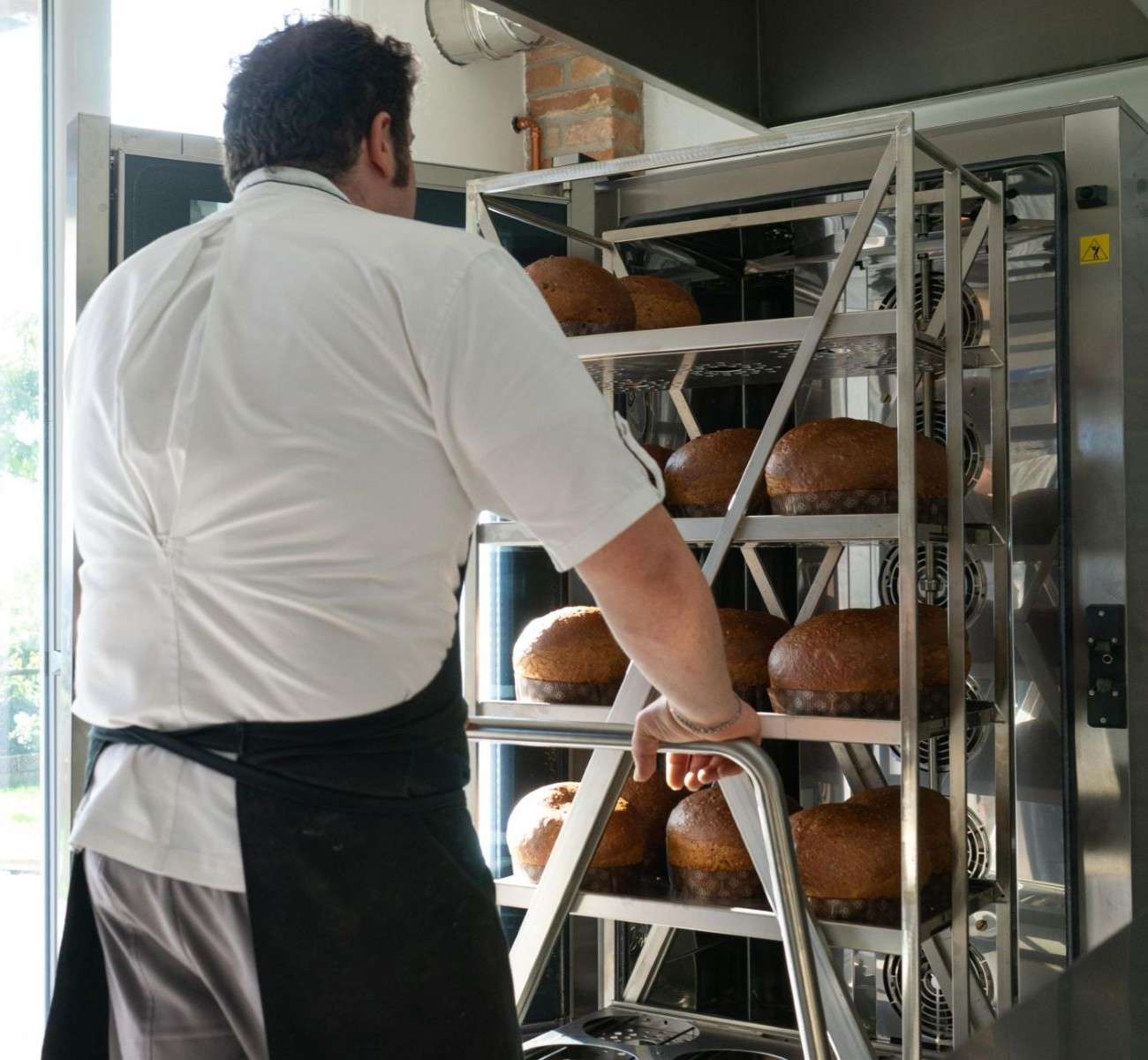
From fermentation to inversion: Unox simplifies every stage of panettone production
When the Christmas peak arrives and you wonder which commercial oven to choose for producing large quantities of panettoni, the answer isn’t just in the performance of the baking chamber, it lies in the efficiency of the entire ecosystem before and after baking. Unox has redesigned the workflow of the pastry kitchen, eliminating bottlenecks and thermal stress through integrated technologies.
Automatic multi-phase control and the “thermal buffer”
The answer is never a fixed number, but a dynamic process. Many artisans ask whether the oven supports complex recipes to manage development without the operator having to constantly adjust the display. The solution lies in the intelligent technology of combi ovens like the Digital.ID™ ranges, which allow precise programming of automatic multi-phase cycles:
- Phase 1 (Development with steam): Balanced temperature and precise steam injection to keep the paper mold elastic and promote maximum volumetric rise.
- Phase 2 (Baking with closed valve): Constant heat to stabilize the internal structure of the crumb.
- Phase 3 (Drying with open valve): Automatic extraction of excess moisture to brown the dome and prevent the panettone from burning on top.
- Phase 4 (Final temperature drop): Controlled cooling to consolidate the structure before removing the panettone from the oven.
Moreover, Unox technology meets the true test for any bakery: managing the oven at full load. The most attentive pastry chef knows that the crucial challenge is in the numbers: if I load a massive batch, say, 40 kg of cold dough at 26°C, will the chamber temperature drop? And how many minutes will it take for the oven to return to the set-point?
The answer lies in the exceptional “thermal buffer” of Unox commercial ovens. Thanks to highly responsive, reinforced heating elements, load-induced thermal shock is immediately compensated, eliminating recovery time to reach the set-point. This ensures perfectly even heat throughout the chamber, preventing the risk that panettoni placed in the center remain underbaked compared to those at the sides.
Additionally, control is entrusted to an ultra-thin multipoint core probe, specifically designed not to damage the texture of large yeast-leavened products. Thermal progress can be monitored precisely, stopping exactly when the core reaches 90–94°C.
Integration of Unox commercial proofers
The panettone production process is long and delicate: it involves about 14 hours of first fermentation, followed by re-mixing, shaping, and another three and a half hours of final proofing in the mold. To optimize this workflow, Unox offers the trolley proofer LIEVOX BIG.
It is designed to accommodate the same rack that will go directly into Unox BIG commercial ovens. This eliminates the need for manual tray handling and reduces the risk of compromising the delicate structure of the raw dough before baking.
The efficiency of BAKE.Rest trolleys
One of the most critical and risky moments in the bakery is post-baking. The soft mass of the panettone collapses if the product is not inverted immediately: if the paper molds remain upright for more than 10 minutes, the structure gives way, creating unsightly side folds. Traditionally, this operation requires two operators, long metal rods, and carries a constant risk of burns.
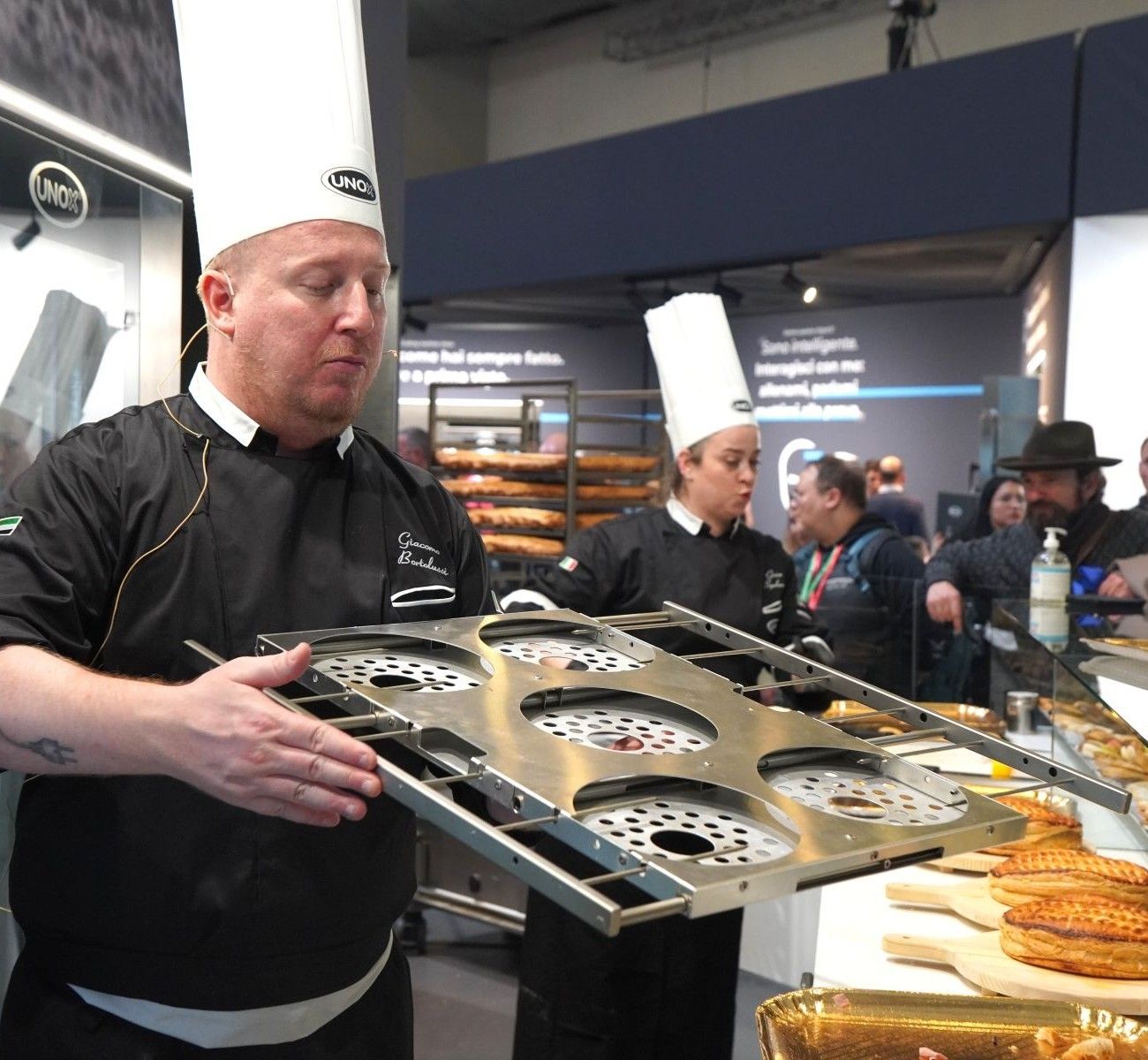
What accessories are needed to bake panettone properly and avoid this stress? Unox commercial trays dedicated to large yeast-leavened products are designed to ensure precision and safety at every stage of the process. The PANETTONE.Bake models (for 1 kg panettoni, mold diameter 165–170 mm) and COLOMBA.Bake models (for 750 g colombe, mold 295 × 205 mm) are made of stainless steel and equipped with integrated symmetric rods. This structure keeps the mold perfectly stable during proofing and baking, ensuring optimal vertical rise, a perfect dome, and a soft, even crumb.
In combination with these trays, the BAKE.Rest trolley system completely revolutionizes post-baking handling:
- The paper mold remains fixed to the prepared tray via the spike, so the dough rises and develops directly around it, without risk of collapse or deformation.
- At the moment of unloading, thanks to the insulating design and trolley handle, a single operator can invert up to 25 panettoni in a few seconds, without ever touching the trays manually.
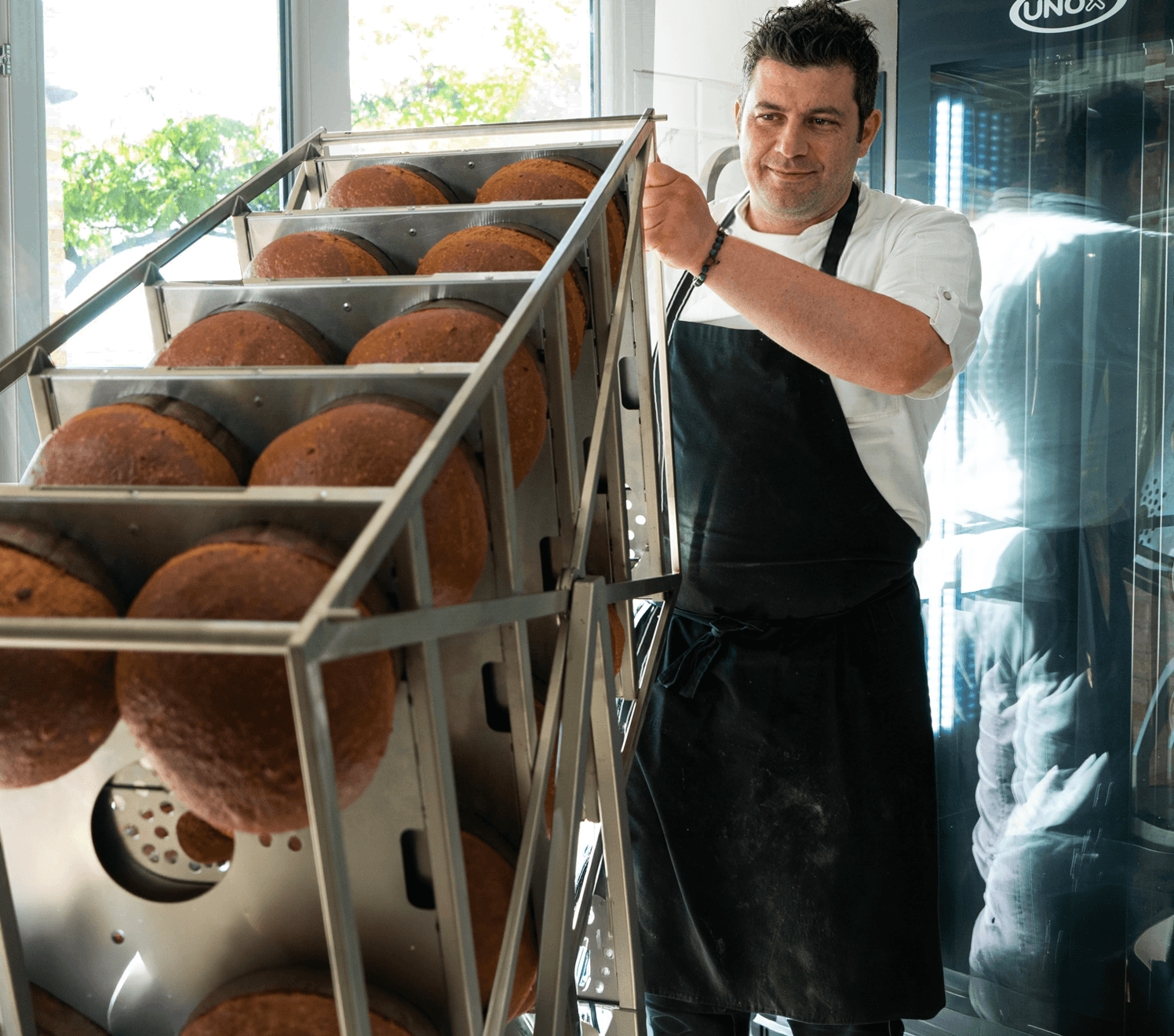
As our Corporate Chef Claudio Novello explains, every step in the bakery is simplified thanks to Unox accessories:
"Anyone who works with large leavened doughs knows the anxiety of losing days of work over a small mistake. It could be due to incorrect measurements, improperly managed baking, or processes that are too slow or cumbersome. Thanks to the multipoint probe, for example, doughs always reach the correct temperature in a controlled way. With the BAKE.Rest trolley, I can not only handle operations more easily but also free up time and resources. In the lab, it takes a colleague just one minute to remove and invert a full load of panettone."
— Claudio Novello, Unox Corporate Chef
Concerns about chamber height and equipment clearance are also eliminated. The chambers of Unox commercial trolley ovens are designed with internal geometry and tray spacing specifically for large yeast-leavened products. The usable height ensures that a 1 kg panettone dome never comes dangerously close to the ceiling. Moreover, space and depth are optimized to allow safe extraction of the trolley and immediate rotation using the BAKE.Rest system, without the domes touching any oven structures during movement.
To complete your bakery setup, discover all Unox accessories dedicated to pastry production and give your business a new boost! Finding them is simple: click the link below and use the filter in the left-hand column to select your needs, for example, set the sector to “Pastry and Bakery” in the professional trays section.
What is the best Unox solution for your pastry kitchen?
Every bakery has different needs: some produce a few large artisanal yeast-leavened products of the highest quality, others must manage seasonal peaks with hundreds of pieces per day, and some look for a versatile solution that can operate year-round across multiple production lines. For this reason, Unox has developed a complete ecosystem of commercial ovens and pastry accessories, designed based on the real experience of thousands of professionals worldwide.
Whether you run an artisanal pastry kitchen, a medium-volume production facility, a large industrial bakery, or a starred restaurant that wants to offer large yeast-leavened products to its guests, Unox provides the technological solution best suited to your needs. From compact countertop models to high-capacity trolley systems, Unox technologies help reduce human error, optimize baking times, and improve operational comfort and safety in the bakery.
Want to find out which Unox combi oven or accessory is best suited to your bakery? We’ve created a dedicated guide to help you choose: you can consult it below and request a free consultation at any time by contacting us directly via chat.