What is a hood for a commercial oven and how does it really work?
When talking about a hood for a commercial oven, it’s important to clarify right away what we are referring to. In the kitchen, in fact, different elements with different functions are often confused: the general ventilation system, the ceiling hood (the typical “central” one found in kitchens), a dedicated hood for the commercial oven and, often, the flue as well. Are hood and ventilation system the same thing? No. And “hood” and “flue” are not synonyms either.
The general ventilation system is the system that ensures air exchange in the environment and helps maintain healthy working conditions. The hood, on the other hand, is a device installed above or near a heat source, professional oven, cooktop or fryer, with the aim of intercepting vapors, fumes, odors and particles before they disperse into the space.
The flue (or exhaust duct) is something else again: it is the duct that carries outside what needs to be expelled, and it becomes especially relevant when talking about gas commercial ovens, because in addition to vapors and odors, you also need to manage combustion fumes.
What is, then, a hood for commercial oven? It is a system designed to extract and treat what is produced during cooking: water vapor, odors, possible fumes and, in some cases, grease particles. Its role is not only related to comfort, but also to safety, hygiene and compliance with current regulations.
What is a hood really used for? It helps reduce the impact of emissions from the commercial oven on the working environment, improving air quality and contributing to maintaining conditions that comply with health requirements. That said, it’s important to be clear: not all hoods eliminate every residue. Effectiveness depends both on the technology used and on the type of cooking.
And here we come to the key point: not all commercial ovens produce the same type of fumes and odors. An oven used for light cooking or regeneration may generate mainly steam. On the other hand, protein-based or particularly fatty cooking can produce more persistent fumes and residues. It is precisely this difference that explains why some professional ovens necessarily require a hood (and, in certain cases, also an exhaust system to the outside), while in other contexts it may be possible to operate without a traditional hood, always in compliance with local regulations.
Understanding the difference between hood, ventilation and flue, and which emissions you really need to manage, is the first step in correctly assessing whether, in your specific case, it is necessary and which solution makes the most sense.
When is it mandatory for a commercial oven to have a hood?
Who decides whether a hood is mandatory for your commercial oven and why some commercial ovens do not require one? Determining whether a hood is mandatory does not depend on a single factor, but on a combination of technical and regulatory elements. Before making a decision, it is important to assess all these aspects:
- Local regulations and guidelines from local health authorities: first of all, you need to find out about the regulations applied in your area. Rules are not the same everywhere: each territory may provide specific requirements regarding ventilation, fume extraction and hygiene standards. That’s why it is essential to verify what is required locally before defining the installation.
- Type of cooking: not all preparations generate the same emissions. Protein-based cooking, especially fatty or high-temperature cooking, produces more intense fumes and odors, which require adequate capture systems. Does grease-free cooking require a hood? In some cases, “cleaner” processes may allow for different choices, if regulations and the operating context permit.
- Type of commercial oven, electric or gas: with a gas professional oven, constraints are generally stricter, because in addition to cooking vapors you must also manage combustion by-products. Does an electric commercial oven need a hood? With an electric oven, on the other hand, the need for a hood is often mainly related to actual emissions and the installation context.
- Kitchen layout: the position of the commercial oven has a significant impact. If it is placed under a central hood or against an already sized wall, management is simpler. If instead it is in a column or outside the ventilated area, dedicated solutions may be necessary to ensure proper removal of vapors and odors.
Ultimately, it’s not enough to ask “do I need a hood?”: the real question is how the oven will be used and in what context it will be installed.
What type of hood should you choose for your commercial oven?
Depending on your type of business, cooking processes, and installation conditions, there are different solutions available. The real question is not just “which hood should I buy?”, but what do I need to manage every day: steam, odors, residues, and which infrastructures do I have available: water, drainage, ceiling extraction, space.
Condensation hood: when it makes sense
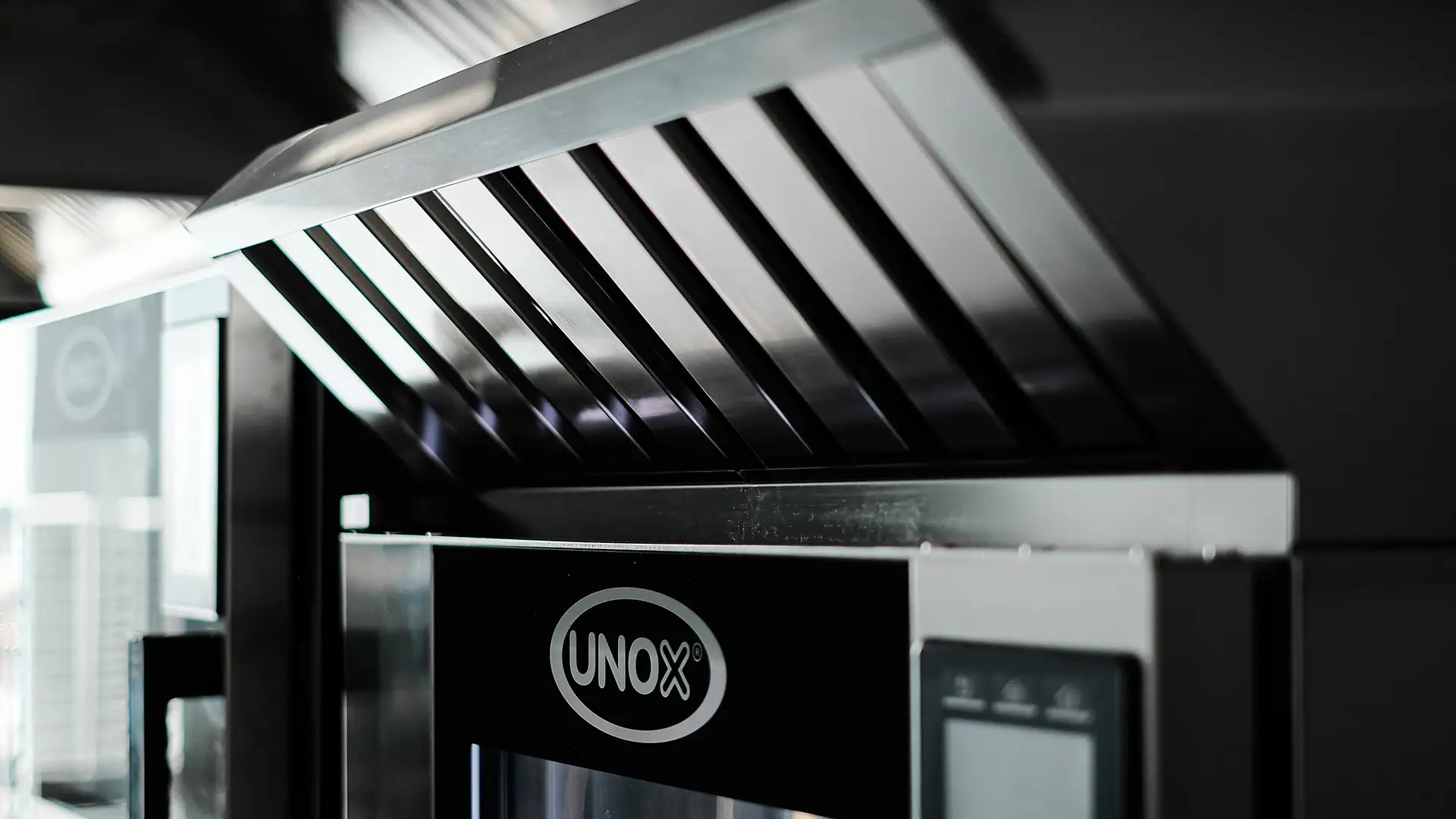
The condensation hood cools the steam produced by the commercial oven, transforming it into condensate, reducing the impact of humidity, heat and odors in the environment. It is the most suitable choice when cooking generates a lot of steam or when the oven operates intensively throughout the day.
A very common question among professionals is: what happens if the hood drips condensate onto the oven or food? In most cases, it is not a “hood problem”, but rather an issue related to drainage and installation. Correct slopes, proper connections and regular maintenance are essential to drain condensate properly. If these aspects are not managed correctly, condensate can become a practical issue, especially in high-demand operational contexts.
This is exactly where the added value of Unox comes into play.
With condensation hoods for Unox commercial ovens, you can rely on safe installation, long-term maintenance and an automatic washing system integrated into the oven, which also includes hood cleaning. This means fewer daily concerns, simplified maintenance and greater durability over time.
Unox condensation hoods can also be equipped with activated carbon filters: replaceable cartridges that further filter the outgoing air after steam abatement, reducing odor impact.
If the goal is not only to “mitigate” residual odors but to further reduce the perception of odors and particles in particularly sensitive environments, it is also possible to integrate catalytic systems, which operate downstream to further treat emissions. They are not designed for heavy or particularly greasy cooking, but they are highly effective for snacks, regeneration and typical bar or corner uses.
Waterless hood: when it is the most logical choice
The waterless hood for commercial ovens is designed for locations where no water connection is available or where it is not desirable to run water to the station. It is particularly suitable for convection ovens and light cooking.
However, it is important to be clear: even if it is “waterless”, residues still exist and must be managed. For this reason, Unox, in addition to offering waterless hoods for its commercial ovens, also develops custom configurations to make disposal more orderly and practical.
To understand what this means, just look at a real-life case. In installations carried out for a major QSR chain like Subway, for example, our R&D team worked on integrated solutions to manage residues more cleanly, avoiding impractical set-ups in the operating area. In some cases, the water coming out of the hood is channelled and drained directly inside the unit, instead of ending up in visible external containers.
As highlighted by Rebekah Crowsley, Global Key Account Segment Development Leader – QSR, who followed the project:
“In the case of structured clients like Subway, details really make the difference. Our R&D team developed a tailor-made solution that allows the water exiting the hood to drain directly into a dedicated tray at the base of the unit, avoiding impractical external collections. It is a simple solution, but essential when you need to ensure order, ease of management and operational reliability on a large scale.”
Visit our dedicated section on the website by selecting your commercial oven model and discovering the available accessories, or, if you prefer direct consultation with one of our team experts, you can write to us directly in chat!
What Unox extraction systems are available for gas commercial ovens?
There are Unox solutions for the extraction and evacuation of fumes from gas commercial ovens. Yes, but it is important to clarify one point: Unox does not manufacture centralized extraction systems. What we do, when we propose a gas commercial oven, is help you find the configuration that best matches the actual layout of your kitchen and the existing system, in order to ensure correct and safe fume evacuation.
When the commercial oven can be installed under a ceiling hood with natural draft, the set-up is more straightforward. But if it is not possible to position it directly under the hood, Unox has developed a dedicated solution to convey the fumes towards the hood anyway, without having to redesign the environment.
In these cases, the Unox flue gas conveyor, installed above the oven, comes into play. It collects the fume outlets into a single outlet and allows them to be correctly guided outside or towards the existing hood. If the critical point is the chimney extension and it proves insufficient, you can complete the configuration with the Unox extension kit, specifically designed to ensure correct fume evacuation and promote safe and efficient oven operation.
For it to work properly, it is essential to follow some practical rules: the duct should remain within approximately 1 meter, it must not be too horizontal (maximum 45°) to avoid stagnation and condensation (a particularly delicate issue in the bakery world). Moreover, it is not recommended to make a 90° bend immediately after the conveyor outlet: it is necessary to leave a straight section at least three times the diameter of the pipe (in practice about 45–50 cm), and only then make the bend and continue towards the outlet. The goal is to discharge fumes without altering the flow and without compromising safety and performance.
To discover all Unox solutions dedicated to extraction systems for gas commercial ovens, visit the dedicated section and do not hesitate to contact us via chat!
Why choose Unox when looking for a hood for your commercial oven?
With Unox, you do not simply choose a hood for your commercial oven: you choose an extraction system designed to truly work in your kitchen and a team ready to support you from the selection phase through long-term management. Here is what makes the difference.
A consistent system, not a generic accessory
The biggest risk is treating the hood as a “universal” accessory. With Unox, on the other hand, the solution is designed to work in balance with the commercial oven: door openings, airflow and steam management are engineered to integrate with each other. The oven design itself contributes to the final result. The automatic washing system helps keep both the oven and the connected system clean, while solutions such as double steam release reduce the sudden escape of steam and fumes when opening. A controlled door closing system, particularly useful in environments with high staff turnover, helps contain dispersion and maintain greater operational continuity.
A wide range of hoods and solutions, based on your needs
Every business has different constraints: type of cooking, intensity of use, available space, presence or absence of water and ceiling extraction. For this reason, Unox offers multiple dedicated solutions and accessories, allowing you to identify the most suitable configuration for your specific case, without forcing a standard solution.
More controlled installation, fewer risks later
Many critical issues arise during installation: incorrect distances, inefficient ducting, improper condensate management. Having clear technical guidelines and design support means preventing problems before they turn into costs or operational downtime. It is a concrete advantage, especially in airport environments or complex systems.
An investment that lasts over time, with continuous support
An extraction system for your commercial oven does not end with installation. Filters, condensate and periodic checks must be managed consistently. Being able to rely on a structured service network and planned maintenance programs reduces the risk of performance drops and operational stoppages.
And in “sensitive” environments such as airports and major hubs, where access to technical areas requires specific authorizations, being able to count on an organization already accustomed to operating in these contexts means intervening more quickly and minimizing the impact on service.
When the hood is strongly recommended, even if not mandatory
There are situations where regulations may not explicitly require a hood for the commercial oven, but where installing one is still a smart technical choice. In these cases, the difference is not so much the type of business, but the intensity of work, the context and operational continuity.
When cooking is frequent or prolonged
Even relatively “clean” cooking, if repeated for many hours a day, can saturate the environment with steam and odors. In venues with continuous production, for example during lunch service or breakfast peaks, a hood helps maintain more stable air and controlled temperatures.
When the oven operates together with other equipment
If multiple grills, fryers or cooking stations are present in the same space, heat and steam add up. Even if the commercial oven, considered individually, might not require a hood, the overall context makes a structured extraction management advisable.
When the commercial oven is not under a central hood
A commercial oven installed in a column or outside the extracted area can disperse steam and odors into the environment, especially in venues open to the public. In these cases, a dedicated solution improves comfort and perceived quality, even if there is no formal obligation.
In environments with high operational sensitivity (airports, stations, major hubs)
In these contexts, there is only one priority: avoiding any critical issue that could interrupt operations. Even when there is no specific legal obligation, the hood often becomes a prudent choice to maintain control over steam and odors and ensure consistent standards in spaces that, very often, were not designed as structured kitchens. In high-traffic environments, non-compliance can quickly result in disputes, operational shutdowns and significant penalties.
In all these cases, the hood is not just a regulatory matter: it is a tool to improve operational comfort, control humidity and temperature, and reduce the risk of problems over time.
When a commercial oven can be used without a hood
There are contexts in which a commercial oven can also be used without a hood, provided of course that local regulations allow it, this is the first thing to verify. Once this is established, as mentioned, the type of food being prepared comes into play. The “cleaner” the cooking process, the easier it is to manage steam and odors without a dedicated hood.
Bars and cafés
In bars, generally, a hood is not necessary when the commercial oven is used for regeneration or for products that mainly develop steam and light aromas: frozen croissants, ready-made snacks, small leavened goods. In these cases, odors are often mild or even pleasant, and the impact on the environment is limited, especially if cooking is not continuous for hours.
Bakery and “light” bakeries
In a bakery, the aroma of bread and products from the commercial oven is often part of the experience. When working with pastry and baked goods (without greasy or protein-heavy processing), it may be possible to operate without a dedicated hood for the commercial oven, always depending on local regulations and ventilation. However, if production is intensive or continuous, it is frequently required to implement at least one solution to manage steam and humidity.
Kiosks, street food and small laboratories
Here, the absence of a hood is more common when the offering is based on regeneration or ready-to-cook products, with limited emissions. As soon as cooking processes that generate persistent fumes (grease, proteins, high temperatures), the situation changes quickly and it may become necessary to provide an extraction system.
Food corners and retail (supermarkets, minimarkets, points of sale)
In bakery corners or “hot counter” points of sale, work is often done with standardized and repeatable products (frozen bread, ready-made viennoiserie, snacks). In these contexts, a hood may not be required if emissions from the commercial oven remain limited, but this is a case where local regulations and layout matter greatly: an oven placed in the middle of the sales area, without extraction, can create comfort issues even if there is no formal obligation.
One last practical point: can I add a hood at a later stage? Often yes, but it is not always straightforward. It depends on space, system routing and oven layout. If you think the menu may evolve, it is advisable to plan from the start for a layout that leaves room for flexibility.
Unox commercial ovens that can be used without a hood
In the contexts seen above, such as bars and cafés, “light” bakeries, kiosks and retail corners, it often happens that the commercial oven is used mainly for quick regeneration, snacks and low-emission baked products, where the impact of steam and odors can be easier to manage even without a traditional hood, always provided that local regulations allow it.
Specifically for these applications, Unox has developed solutions dedicated to quick service and the front-of-house world: commercial ovens designed for “clean” processes, with controlled emissions, not intended for protein-heavy cooking or high grease production. It is this technical characteristic that allows their use, in certain cases, even without a traditional hood.
This is the case with solutions such as our commercial speed ovens SPEED.Pro™ and SPEED.Compact™, developed for bars, kiosks, corners and points of sale where space is limited and processes are predominantly light.
SPEED.Pro™ is a commercial baking speed oven that combines microwave and convection in a single unit. It is designed for bar snacks, ready-made products and quick regeneration, allowing multiple items to be prepared simultaneously in the same cooking chamber. It is not intended for protein-heavy or particularly greasy cooking: for this reason, emissions are limited and, in compliance with local regulations, it can also be used without a traditional hood.
The commercial speed oven SPEED.Compact™ ECO, fast and compact, easily adapts to the counters of any business. It integrates double-chamber catalytic filters and a flue that filter fumes and odors, reducing environmental impact without the need for a ceiling hood. This makes it particularly suitable for retail and front-of-house contexts, ensuring a more comfortable environment for both staff and customers.
On this dedicated page, you can explore our complete range of accelerated cooking commercial ovens and discover which solution best suits your needs, or write to us directly in chat for tailored consultation!
If you are interested in convection commercial ovens for your business, keep in mind that for snacks and “clean” baked products it may be possible to operate even without a hood (if local regulations allow it). In these cases, you can consider the Unox BAKERLUX range, designed for pastry, snacks and bread, including from frozen.
In this section of the website you can find the complete range!